

A HIFU appointment involves more than placing a device against the skin: treatment depth, facial anatomy, energy settings and operator technique all affect what you feel and what you see afterward. By the end, you will know how the appointment unfolds, which changes are realistic, how long results may last and which questions to ask before booking.
Key takeaways
- HIFU suits mild-to-moderate laxity, not heavy tissue descent.
- Ask which device, indication clearance and treatment depths your provider uses.
- Expect brief treatment discomfort and little to no downtime.
- Results develop gradually; your clinician will decide whether repeat sessions are appropriate.
Which facial areas can HIFU treat, and who is it suited to?
HIFU treatment areas are best suited to mild-to-moderate skin laxity, not heavy tissue descent. A clinician should examine laxity, facial fat volume and asymmetry, take baseline photographs, and confirm that the device has clearance for the proposed indication rather than assuming every product marketed as HIFU is equivalent.
| Area | Possible goal | Important limitation |
|---|---|---|
| Brow | Brow lifting | Avoid the eyelids and protect the eyes |
| Cheeks | Mild tightening | Does not replace lost volume or lift descended tissue |
| Jawline | Jawline tightening | Heavy jowls may need surgery |
| Under-chin | Under-chin HIFU treatment | Assess fat thickness and nearby nerves |
| Neck | Neck skin tightening | Do not treat casually over the thyroid area |
The eyelids, lips, thyroid area, open wounds, active infections and significantly inflamed skin require avoidance or an individual medical decision. Implanted devices, facial implants, pregnancy, bleeding risk and recent procedures also belong in the medical review.
HIFU deposits focused thermal coagulation points at selected tissue depths, prompting contraction and collagen remodelling. It does not cut away excess skin, reposition the SMAS or suspend descended tissue. Marked jowls, substantial skin excess, or major fat or muscle descent may therefore need a facelift or neck lift for a larger change.
In HIFU versus facelift, the practical distinction is modest gradual tightening versus surgical removal and repositioning.
What happens during a HIFU appointment?
A HIFU appointment usually takes about 30 to 90 minutes, depending on the number of areas and the device. The HIFU appointment steps follow a set sequence, but the treatment plan should be individual rather than based on a standard pulse count.
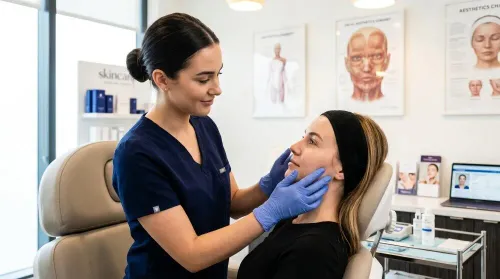
1. Consultation: The clinician reviews your medical history, examines skin thickness and tissue volume, confirms the areas to treat, and checks for reasons to postpone treatment.
2. Cleansing: The face is cleansed to remove makeup, sunscreen, oil and residue that could interfere with contact.
3. Mapping: The practitioner marks treatment zones and lines, avoiding bone, vulnerable anatomy and areas outside the device’s approved indication.
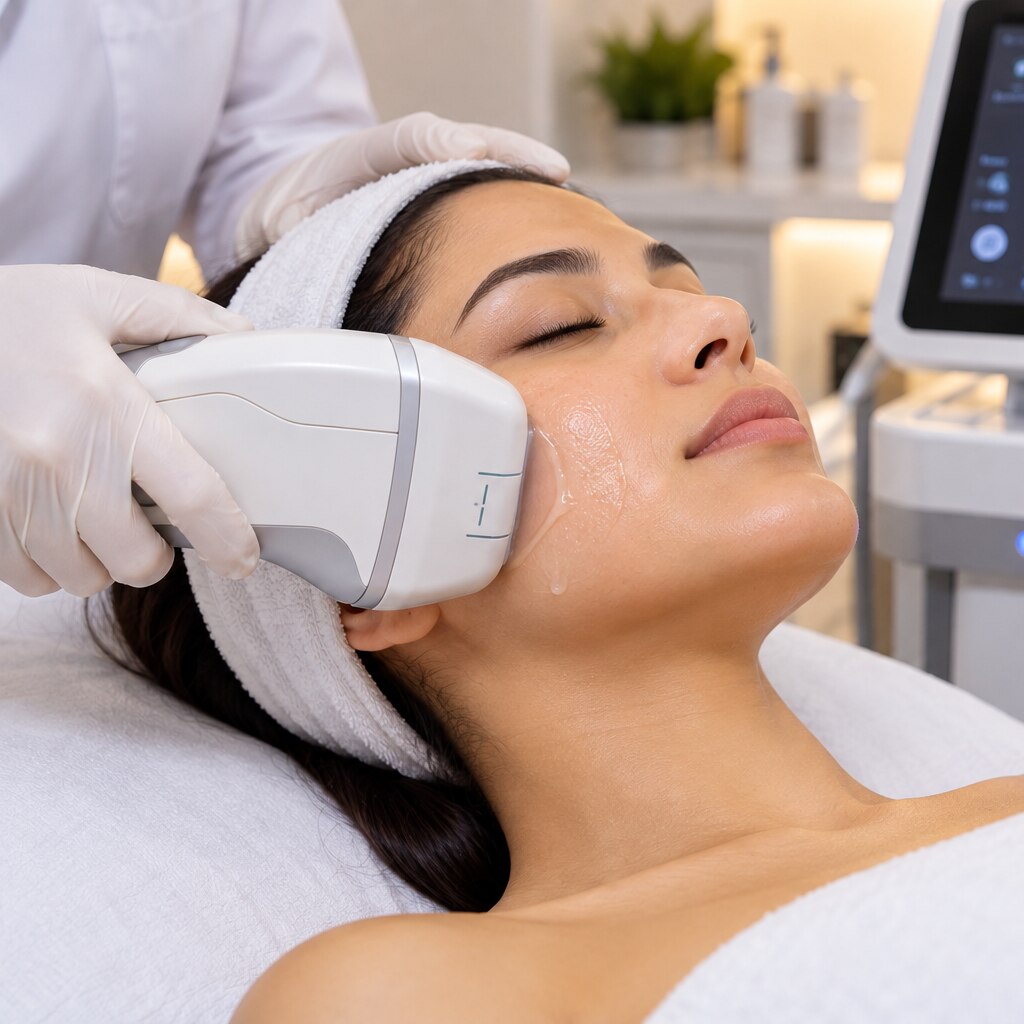
4. Gel application: Ultrasound gel is spread over each area. It creates the contact needed for energy to pass from the handpiece into the skin.
5. Handpiece placement: The clinician places the handpiece firmly against the mapped skin and selects HIFU cartridges for the intended tissue plane.
6. Energy delivery: Individual ultrasound lines or pulses are delivered at controlled depths. Common options include 1.5 mm, 3.0 mm and 4.5 mm ultrasound depth settings; selection depends on skin thickness, subcutaneous tissue and the area treated.
7. Gel removal: The gel is wiped away, and the treated skin is checked before you leave.
Ultrasound visualisation can display tissue layers, confirm the intended depth and help the operator avoid bone or vulnerable structures. A device label alone does not prove equivalent precision. Most patients need no fasting, shaving, routine pain medicine or escort; ask about numbing cream, medication interactions and history-specific instructions.
What does HIFU feel like, and what is recovery like?
Individual pulses can feel like heat, pressure, prickling, tingling or a brief sharp sensation. This HIFU treatment sensation varies by area and energy setting. HIFU pain usually stops with the pulse, although repeated lines can leave the treated area tender. Heat and prickling during HIFU do not mean the treatment has failed.
1. Before treatment, disclose active infection, open wounds, significant inflammation, implanted electronic devices, facial implants, pregnancy, bleeding risk and recent procedures. Treatment may need postponement or an individual medical decision.
2. During energy delivery, tell the clinician if discomfort becomes intense or continues between pulses. Correct settings should keep each sensation brief and controlled.
3. Immediately afterwards, expect possible sensitivity, aching or tingling. HIFU recovery time is usually several hours to a few days rather than prolonged downtime.
4. Mild redness, swelling and tenderness can occur during the first day. Follow the clinician’s skin-care instructions and avoid adding heat, friction or unapproved products.
5. Seek prompt clinical review for blistering, a burn, persistent numbness or altered sensation, worsening swelling, facial asymmetry or facial nerve weakness. These are not routine HIFU side effects.
Ultrasound gel must maintain full contact between the handpiece and skin; poor coupling can create hot spots. Appropriate depth, controlled energy and avoidance of vulnerable anatomy reduce injury risk to skin, nerves and deeper tissue.
When will you see results, and how many sessions might you need?
Skin may feel tighter immediately after HIFU because of short-term tissue contraction and swelling, but that sensation is not the finished result. Visible improvement develops as collagen remodelling after HIFU unfolds over several weeks.
At 60 to 180 days, HIFU results are commonly assessed because collagen changes and tissue contraction have had time to develop. Take comparison photographs in the same lighting and position; judging the result after a few days can mistake temporary firmness for lasting tightening.
The number of HIFU sessions depends on your laxity, treatment area, tissue thickness and the change you want. A clinician may recommend:
- One session for a modest degree of laxity and a conservative improvement
- A review after the first result has matured before considering another session
- A repeat session only when residual laxity justifies its risks and expected benefit
More lines, higher energy or more frequent HIFU sessions do not guarantee a better result. Excessive or poorly placed energy can increase pain, burns, prolonged sensory changes and the facial fat loss risk, particularly where little subcutaneous tissue covers the treatment plane.
Ask how the plan protects facial volume rather than choosing the largest pulse count.
HIFU results duration is often reported at roughly 3 to 12 months, but age, laxity, sun exposure, weight change, facial volume and natural ageing affect persistence. Evidence for reliable benefits over several years and fixed routine repeat schedules remains limited, so a clinician should reassess you before every further treatment.
How should you compare HIFU providers before booking?
Compare the treatment plan, not the promotional pulse count. A quoted number of lines or pulses is not a reliable measure because protocols vary by device, cartridge depth, energy setting, spacing and facial area.
For how to choose a HIFU clinic, ask these questions:
- Which HIFU device and cartridge depths will you use?
- Does it provide ultrasound visualisation for ultrasound-guided HIFU?
- Which areas will you treat: brow, cheeks, jawline, under-chin area or neck?
- How will you select energy and spacing for my skin thickness, fat volume and anatomy?
- Who will perform the treatment, and what qualifications and supervision apply?
- Can I see my proposed treatment map and baseline photographs?
- Will you explain expected improvement, adverse effects, follow-up, alternatives and what happens if the result is limited?
Use this HIFU device comparison to test whether the plan contains evidence rather than sales language:
| Comparison point | Useful evidence | Warning sign |
|---|---|---|
| Device and depth | Named device, cartridges and intended tissue plane | “HIFU” with no model or depth |
| Treatment design | Marked map showing areas, lines, energy and spacing | One package for every face |
| Results | Before-and-after images with matching lighting, angle and facial expression | Uncontrolled or heavily edited photographs |
| Clinical care | Examination, risk discussion and documented follow-up | Pulse count presented as the outcome |
A doctor-supervised HIFU consultation in Mumbai at Dr Skin N You can bring examination, mapping, risk discussion and the HIFU treatment plan together instead of selling a generic package. Proceed only after the clinician has examined your anatomy and explained what HIFU can and cannot change.
Related service
HIFU Treatments HIFU (High-Intensity Focused Ultrasound) Treatments are advanced, non-surgical skin tightening and rejuvenation procedures offered by Dr. View service → |
Frequently asked questions
Which facial areas can HIFU treat?
HIFU can be used on areas such as the jawline, lower face, cheeks, neck and under-chin region when laxity is mild to moderate and the treatment is appropriate for your anatomy.
What happens during a HIFU appointment?
A clinician examines laxity, facial fat volume and asymmetry, takes baseline photographs, confirms the device and indication, cleans the skin, marks treatment zones and delivers focused ultrasound pulses at selected depths.
What does HIFU feel like, and what is recovery like?
You may feel brief heat, tingling, pressure or sharp pulses during delivery. Redness, tenderness, swelling or sensitivity can occur afterward, while most people resume normal activities quickly.
When will you see HIFU results, and how many sessions might you need?
Changes develop gradually as collagen remodelling occurs. The number of sessions depends on laxity, treatment response, device settings and your clinician’s assessment rather than a fixed schedule.
How should you compare HIFU providers before booking?
Ask who performs the treatment, which device and indication clearance they use, how they assess facial anatomy, what treatment depths they plan, how they manage complications and whether they take baseline photographs.