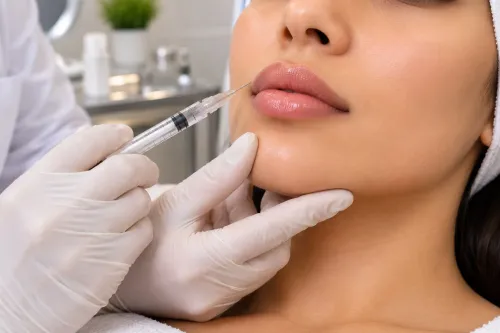



Anti-wrinkle injections temporarily reduce nerve signals to selected facial muscles, so their effect develops gradually and then fades as normal muscle communication returns. Knowing which lines respond, when to judge the result, and what affects duration helps you decide whether treatment and later maintenance are appropriate.
Key takeaways
- Anti-wrinkle injections relax movement; fillers add volume beneath the skin.
- Results develop gradually, with the final effect assessed after about two weeks.
- Effects wear off as nerve–muscle signalling and muscle movement return.
- A review should assess results, side effects, goals, and whether treatment is still suitable.
What anti-wrinkle injections do—and how they differ from fillers
Anti-wrinkle injections usually contain prescription botulinum toxin type A, a neuromodulator that temporarily reduces acetylcholine release at the nerve–muscle junction. The selected facial muscles then contract less strongly, softening creases caused by repeated movement.
Anti-wrinkle injections and dermal fillers solve different problems:
| Treatment | What it does | Common uses |
|---|---|---|
| Anti-wrinkle injections | Reduces selected muscle movement | Forehead lines, frown lines between the eyebrows and crow’s-feet |
| Dermal fillers | Adds volume or structural support | Lips, cheeks and facial folds |
These injections work best when muscle activity causes or deepens the crease. A line that remains visible while your face is relaxed may relate more to sun damage, skin laxity or volume loss, so it needs a separate assessment rather than automatic toxin treatment.
The aim is reduced movement, not complete immobility. The clinician adjusts dose and placement to preserve natural expression and limit asymmetry, an unnatural appearance or an unwanted brow shape.
Do not compare quoted units between brands as though they were identical. Botulinum-toxin units are product-specific, and one formulation’s dose cannot be converted one-for-one into another formulation’s units. A treatment plan must therefore identify the product used, the muscles targeted and the reason for the selected dose.
What happens during treatment, and when will you see the result?
You will not see the finished result on the day of treatment. During the consultation, the clinician reviews your concerns, medical history and goals before examining how your face moves.
For a facial-muscle assessment, you will be asked to raise your eyebrows, frown and smile. The clinician studies the strength and pattern of movement, then marks your skin to guide the injection points. Their number depends on the areas treated, muscle strength and planned dose—not on a universal template.
A fine needle delivers the injections, and the appointment is usually brief. The exact time depends on how many areas require treatment. An in-person consultation at a doctor-supervised clinic such as Dr Skin N You matters because the injector can assess your movement and choose placement instead of treating from a fixed menu.
| Timing | What happens | What you should expect |
|---|---|---|
| Appointment day | The marked areas are injected | Do not expect the final result immediately |
| 1–3 days | Early reduction in muscle movement may begin | Notice changes without judging the outcome |
| 10–14 days | The effect has largely developed | Assess the developing result and any asymmetry |
The 10–14 days review gives the clinician a useful point to assess the result while checking whether movement and balance match the plan. A review does not automatically mean that more injections are needed; additional toxin could create unwanted weakness.
Related service
Anti- wrinkle injections Anti-wrinkle injections are advanced, non-surgical aesthetic treatments offered by Dr. View service → |
How long do the effects last, and why do they wear off?
For most people, how long anti-wrinkle injections last is about 3–4 months. Some people see visible movement return before three months, while others retain the cosmetic effect for longer.
The timeframe changes with:
- The treated muscle and its strength
- The dose and product used
- Your metabolism
- How frequently the muscle moves
- Whether this is your first treatment
- Your response after previous sessions
Strong, frequently used muscles can regain visible movement sooner. Your response can also change after earlier sessions, so a previous duration does not guarantee the next one.
The result is not complete the moment you leave the appointment. Reduced movement can begin after 1–3 days, develops over the first two weeks, and then gradually diminishes over the following months.
The effect wears off because nerve endings gradually recover communication with the muscle, while new nerve terminals form. The muscle is not permanently paralysed. As muscle movement returns, treated wrinkles can become visible again.
Anti-wrinkle injections reduce movement-related lines; they do not stop ageing, sun damage, skin laxity or volume loss. A line that remains visible while your face is relaxed may need a different assessment, even when the injection has worked as intended.
When is maintenance appropriate, and what should a review decide?
There is no safe, fixed retreatment date for everyone. A clinician usually waits until the previous treatment has taken effect and then diminished before considering another session, rather than injecting again at very short intervals. A cosmetic effect often lasts about three to four months, but your treated muscle and response determine the timing.
A two-week review helps assess the early final result, remaining movement, asymmetry and unwanted weakness. It does not mean more toxin should automatically be added. Additional injections increase exposure and can worsen drooping or other weakness.
The review should decide:
- Whether the treated area still has the intended reduction in movement.
- Whether visible movement has returned enough to justify maintenance treatment.
- Whether asymmetry, eyelid or brow drooping, or another weakness needs observation instead of further injections.
- Whether your response, dose and treatment history support another session.
Licensed product information commonly limits treatment frequency because unnecessarily frequent or high-dose exposure may increase antibody formation and reduce response. Follow the recommended retreatment interval for the specific product, not a calendar copied from someone else.
The final decision requires an in-person assessment that considers the treated area, your response and whether movement has returned. Maintenance manages movement over time; it does not permanently erase wrinkles or halt ageing.
What should you check before treatment, and which symptoms need help?
Postpone injections if the proposed site has an infection. Tell the clinician before treatment about:
- Neuromuscular disorders or previous reactions to botulinum toxin
- Pregnancy or breastfeeding
- Recent facial procedures
- Aminoglycoside antibiotics
- Medicines that affect neuromuscular transmission
These details can change whether treatment should proceed, where injections are placed, or how much product is used.
| Symptom pattern | Examples | What to do |
|---|---|---|
| Common short-term effects | Injection-site pain, redness, swelling, bruising or headache | Monitor; contact the clinic if symptoms are severe or worsening |
| Nearby muscle weakness | Eyelid drooping, eyebrow drooping, dry eye, excessive tearing, double vision or facial asymmetry | Contact the treating clinician for advice and assessment |
| Possible spread of botulinum-toxin activity | Generalized weakness, difficulty swallowing, speech problems or breathing difficulty | Seek urgent medical assessment; do not wait for the cosmetic effect to fade |
Eyelid drooping and mild asymmetry result from temporary weakness in nearby muscles and often improve as the treatment wears off. Breathing difficulty, swallowing trouble, speech changes or weakness beyond the treated area need urgent medical assessment.
Choose an assessment that covers your medical history, facial-muscle movement, planned dose and follow-up. Before leaving, ask which side effects require prompt contact, whom to call outside clinic hours and where to seek urgent help.
Frequently asked questions
How do anti-wrinkle injections differ from dermal fillers?
Anti-wrinkle injections reduce selected muscle contraction by blocking acetylcholine release temporarily. Dermal fillers add volume beneath the skin to address concerns such as lost fullness or deeper folds.
When will you see the results of anti-wrinkle injections?
Movement usually reduces gradually after treatment, so assess the result once the effect has fully developed, often around two weeks.
How long do anti-wrinkle injections last?
The effect is temporary and wears off as nerve–muscle signalling and muscle movement return. Duration varies with the treated muscle, dose, treatment plan, and individual response.
When is maintenance treatment appropriate?
Schedule maintenance only after reviewing the result, side effects, treatment goals, and whether movement or lines have returned. A clinician should decide whether further treatment is suitable.
What symptoms need medical help after treatment?
Contact your treating clinician for unexpected or worsening symptoms. Seek urgent medical help for trouble breathing, swallowing, speaking, marked weakness, or a severe allergic reaction.