

Laser tattoo removal does not lift all ink out of your skin in one appointment. Short pulses fragment pigment, then your immune and lymphatic systems clear the smaller particles over the following weeks. By the end, you will know how laser type, ink colour, tattoo depth, body location and treatment timing shape the likely session count.
Key takeaways
- Expect treatments every six to eight weeks so your body can clear fragmented ink.
- Black ink often responds differently from lighter colours, while depth and location affect fading.
- Your skin type, tattoo characteristics and comfort level all shape treatment planning.
- Success means meaningful fading, even when a small amount of pigment remains.
How laser pulses break tattoo ink into particles your body can clear
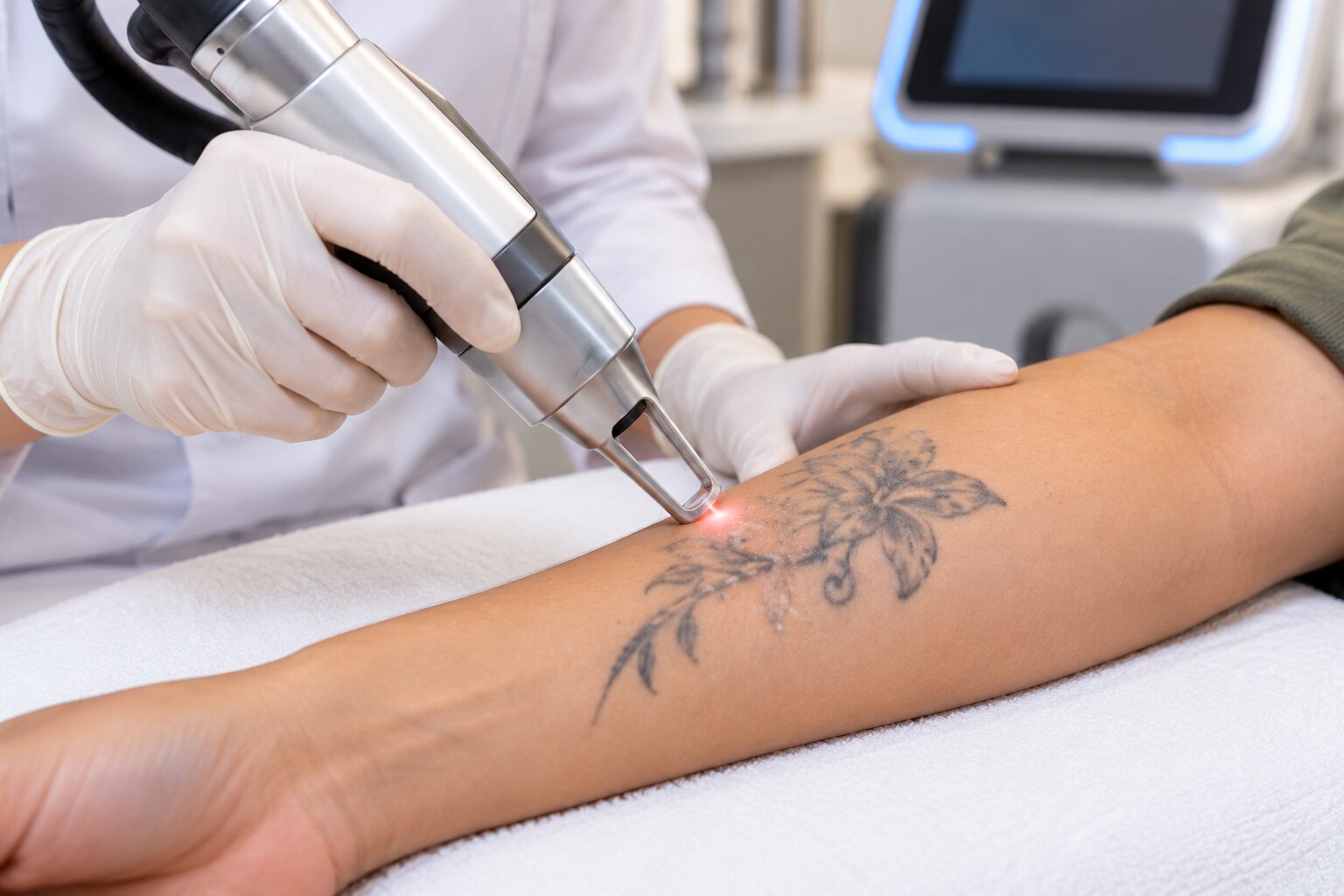
Laser tattoo removal works by directing very short, high-energy pulses into tattoo pigment. The ink absorbs the light more strongly than surrounding skin, producing a photothermal effect that rapidly heats the pigment. A photoacoustic shock also breaks larger ink deposits into smaller particles.
The laser does not evaporate every particle in one treatment: immune cells carry fragments into the lymphatic system, so fading continues for weeks. Immediate whitening, called frosting, is an acute optical reaction, not proof that the tattoo has disappeared.
| Technology | Pulse duration and action | Practical distinction |
|---|---|---|
| Q-switched laser | Usually nanosecond pulses that heat and fracture pigment | An established option for many ink colours and tattoo depths |
| Picosecond laser | Pulses shorter than one nanosecond, creating stronger mechanical, or photoacoustic, fragmentation | Can improve response for some pigments, but is not automatically better for every tattoo or skin type |
The wavelength must match the pigment. A 532 nm wavelength is commonly selected for red, orange and some yellow tones, while 1064 nm reaches deeper blue and black pigment. Ink chemistry, density and depth still influence the response, so neither a Q-switched laser nor a picosecond laser suits every colour.
The treatment choice depends on the tattoo’s pigment and your skin, not simply on which device has the shortest pulse.
Why ink colour, depth and body location change the session count
Six laser tattoo removal sessions may clear a sparse, amateur black tattoo, while dense professional ink or a cover-up can require ten or more. Size matters, but ink chemistry, depth, layering, body location and your immune response matter just as much.
| Factor | Fewer sessions | More sessions |
|---|---|---|
| Ink and wavelength | Black ink responds to a 1064 nm wavelength; red, orange and some yellow respond to a 532 nm wavelength | Blue or green pigment may need a 755 nm wavelength or 694 nm wavelength; mixed colours require multiple approaches |
| Ink placement | Shallow, lightly packed amateur ink | Deep, dense professional ink, or a cover-up layered over an older tattoo |
| Body location | Chest, upper arm or another area with stronger circulation | Feet, ankles, lower legs and hands, where clearance can be slower |
| Skin and healing | No major tissue change and a steady immune response | Scarring, altered texture, smoking or slower immune clearance |
The Kirby–Desai scale combines skin type, location, colour, ink quantity, scarring and layering to estimate treatment numbers. It is a population-based guide, not a promise: darker skin needs careful wavelength, energy, cooling and spacing because melanin also absorbs laser energy, raising the risk of temporary darkening or lightening.
A tattoo that has faded with time can still need many treatments if its remaining pigment is deep or tightly packed. Expect more than ten sessions when several difficult features occur together.
Why sessions are spaced six to eight weeks apart
Wait six to eight weeks between laser sessions. This treatment spacing gives the epidermis time to heal and allows immune cells and lymphatic pathways to remove fragmented pigment. Treating settled skin sooner does not force ink out faster; it adds energy to healing tissue and raises the risk of irritation and pigmentary complications.
Tattoo fading continues after the immediate laser reaction has settled, so the laser tattoo removal timeline cannot be judged on treatment-day appearance. The white frosting seen during a pulse is a short-lived optical reaction, not proof that the ink has disappeared.
Delayed pigment clearance can make the tattoo look lighter several weeks later, then progress slows before the next appointment.
Judge a response with photographs taken in the same lighting, distance, and camera angle before each treatment. Genuine fading appears as a gradual reduction in ink density and definition, with lighter colour between appointments. Compare the healed tattoo, not temporary redness or a scabbed surface.
If the area remains tender or visibly irritated, wait until the skin recovers and ask the treating clinician to reassess the interval. Some tattoos need more than eight weeks when healing is slow or pigment is still clearly lightening; a healed surface and a sustained trend matter more than a fixed calendar.
What happens during treatment and how discomfort and skin type affect planning
Expect a consultation, a brief laser session and several weeks of gradual fading—not instant removal. The laser tattoo removal procedure is planned around ink colour, depth, skin tone and any previous treatment.
1. Before treatment, your clinician examines the tattoo, asks about medicines and scarring, and records your natural skin colour. Avoid tanning and tell them about prior reactions. Darker skin needs careful wavelength and fluence selection because melanin competes with tattoo pigment; cooling and longer treatment intervals reduce the risk of post-inflammatory hyperpigmentation or hypopigmentation.
Dr Skin N You can use a test spot to check how your skin and pigment respond before treating a larger area.
2. During treatment, you wear protective eyewear while short laser pulses target the ink. Laser tattoo removal pain is often described as hot pinpricks or elastic-band snaps; cooling and topical anaesthetic can improve comfort. Immediate white frosting is an optical reaction, not proof that the ink has disappeared.
Redness, swelling, pinpoint bleeding or blistering can follow.
3. Afterward, keep the area clean, avoid picking blisters or crusts, and protect it from sunlight. Pigment clearance continues through immune and lymphatic processes, so fading can proceed for weeks after the visible reaction settles.
Cosmetic tattoos need special caution: iron oxide or titanium dioxide can turn black, grey or another unexpected colour, making a test spot and explicit counselling essential.
Related services
Tattoo removal Tattoo Removal is a safe and effective treatment offered by Dr. View service → |
Q-switch lasers Q-Switch Laser Treatments are advanced dermatological procedures offered by Dr. View service → |
What counts as a successful result when some pigment remains
A successful result is not always complete tattoo removal. If the skin is smooth, healthy, and the image is no longer distracting, faint residual pigment or a ghost outline may be an acceptable endpoint—especially when further treatment would add risk without meaningful visual gain.
Ink can sit at different depths, and some colours resist the available wavelength; uneven clearing leaves a shadow or border.
Altered texture can result from the original tattoo, repeated inflammation, scarring, or treatment-related changes in collagen. Discuss tattoo removal complications, including lighter or darker skin, persistent scarring, and incomplete clearance, before chasing the last traces.
- Tattoo removal creams do not selectively reach ink in the dermis; they can cause burns, dermatitis, infection, or scars.
- Abrasion and DIY chemical peels remove or injure surface skin, not ink at depth, so they can replace a faint mark with obvious texture or discolouration.
- Surgical excision removes a section of tattooed skin, but closure leaves a scar and may be a worse trade-off for a large or poorly placed tattoo.
A clinician should compare the remaining pigment with the risk of another laser session or a destructive alternative. Clearer is not automatically better if the method creates a permanent scar.
Frequently asked questions
How does laser tattoo removal break up ink?
Very short, high-energy laser pulses target tattoo pigment. The ink absorbs the light, heats rapidly and experiences a photoacoustic shock that breaks larger deposits into smaller particles for the body to clear.
Why do some tattoos need more sessions than others?
Session counts vary with ink colour, pigment depth and body location. These factors affect how strongly the ink responds to laser energy and how efficiently your body clears the fragmented particles.
Why are laser tattoo removal sessions spaced six to eight weeks apart?
The interval gives your body time to clear fragmented ink and gives treated skin time to recover before the next laser session.
What counts as a successful tattoo removal result?
Success can mean substantial, useful fading rather than complete removal. A small amount of pigment can remain after treatment, depending on the tattoo and how your skin responds.