

Hair thinning has several causes, and injections cannot work well when the diagnosis is wrong or the follicles are already scarred or destroyed. You will learn how PRP and GFC are prepared, which hair-loss patterns they fit, what results are realistic, and how to compare them with medicines, devices, microneedling, and transplantation.
Key takeaways
- Confirm the diagnosis before choosing PRP or GFC for hair thinning.
- Ask how blood is processed and what the injection protocol includes.
- Expect gradual improvement in shedding and density, not instant regrowth.
- Compare PRP or GFC with medicines before committing to sessions.
What happens during a hair PRP or GFC session
A session begins with a blood draw, followed by separation of the useful blood component. For hair PRP preparation, the sample undergoes centrifugation for hair loss treatment. This spinning separates platelet-rich plasma from red cells and other blood layers.
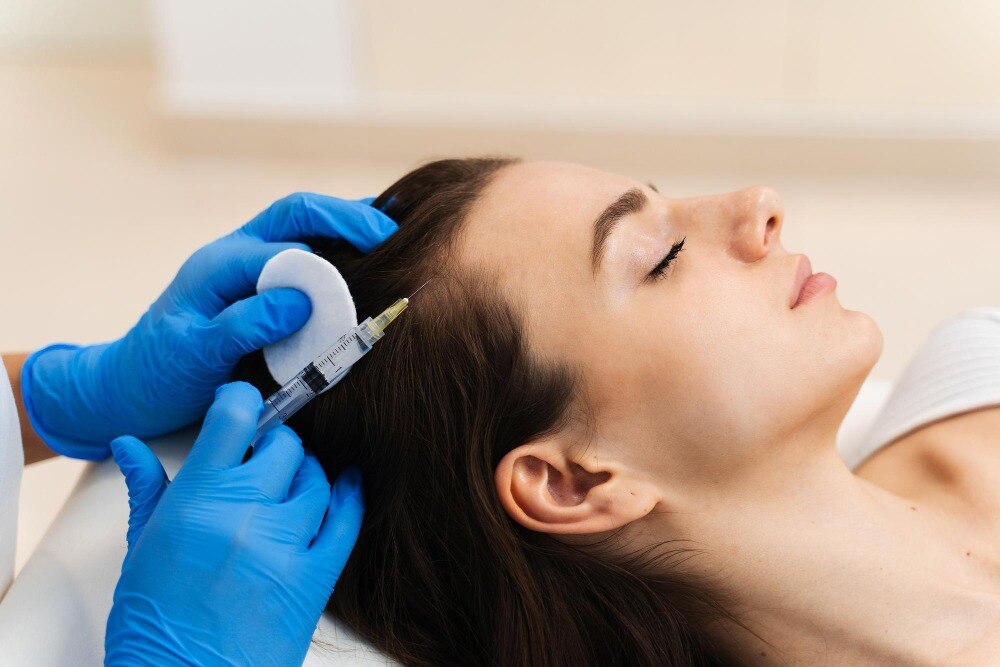
After the scalp is cleaned and, if needed, numbed, the clinician injects small amounts of PRP into thinning areas at planned points and depths.
GFC preparation also starts with your blood draw, but “growth factor concentrate” does not identify one standard worldwide method. A processing system may concentrate or release platelet-derived growth factors and remove much of the cellular material; another system may retain different blood components.
Ask which kit and processing steps are used, because results from one GFC system cannot automatically be applied to another or to PRP.
Around a viable follicle, injected PRP or GFC is intended to influence signals from the dermal papilla, support the local hair-cycle environment, and encourage small blood-vessel development around the follicle.
These actions aim to help miniaturized follicles produce thicker hairs; they do not create new follicles or permanently remove the genetic tendency behind pattern hair loss. Treatment has a more plausible target where follicles still exist than in completely bald, scarred, or destroyed skin.
Which hair-loss diagnoses fit PRP or GFC treatment
PRP or GFC is most defensible when examination confirms androgenetic alopecia, with miniaturized but still viable follicles. Hair shedding alone is not a diagnosis: telogen effluvium, alopecia areata, thyroid or iron deficiency, medication effects, traction, and scarring disease need different treatment.
| Diagnosis | Typical clues | PRP/GFC decision |
|---|---|---|
| Androgenetic alopecia | Gradual widening part, receding hairline, or crown thinning; mixed thick and miniaturized hairs | Best-supported indication; discuss injections when follicles remain active |
| Telogen effluvium | Increased shedding across the scalp, often two to three months after illness, stress, weight loss, or childbirth | Investigate and correct the trigger first; PRP or GFC is not a substitute |
| Alopecia areata | Sudden smooth round patches, broken hairs, or eyebrow loss | Needs a dermatologist’s assessment and usually disease-directed treatment before injections |
| Traction alopecia | Loss along the hairline where tight styles, extensions, or helmets pull repeatedly | Stop traction; injections are less useful if follicles have been damaged for a long time |
| Scarring alopecia | Pain, burning, scale, pustules, redness, or shiny skin without visible follicle openings | Do not delay diagnosis; destroyed follicles cannot be reliably restored with PRP or GFC |
Ask for scalp examination and trichoscopy before consenting. Sudden patchy loss, rapid progression, inflammation, pain, scaling, or scarring warrants prompt review; blood tests such as a complete blood count, ferritin, and thyroid-stimulating hormone may be appropriate. GFC is not one standard product, so evidence from one preparation does not automatically apply to another.
What results can PRP or GFC realistically support
The most realistic gain is better coverage from existing follicles, not a new hairline. In pattern hair loss, PRP or GFC can support hair shedding reduction and make miniaturised follicles produce thicker strands. The change appears as improved density because fewer hairs are lost and each surviving hair occupies more visual space.
Thickening depends on whether the follicle remains viable. An increase in hair shaft calibre can make fine, translucent hairs easier to see, but it does not permanently remove the genetic tendency behind pattern loss. Results also vary between PRP and GFC systems because their platelet, cell and growth-factor content differs.
A smooth area that has looked bald for years is unlikely to regrow substantial hair from injections alone. PRP or GFC cannot create new follicles, and scarred follicles cannot produce hair unless the underlying condition is treated; transplantation may be the option for permanently lost follicles.
Earlier thinning, where short fine hairs remain, offers a more plausible target than a shiny, scarred patch.
Judge progress against the hair growth timeline, not against photographs taken a week apart. Shedding changes can precede visible thickening, while density assessments usually need consistent photographs or trichoscopy at about three to six months and continued follow-up.
A lack of improvement should prompt a review of the diagnosis and protocol rather than automatic repeat sessions.
How PRP and GFC compare with medicines and other hair-loss treatments
PRP or GFC usually serves as an adjunct, not a replacement, for treatments that slow miniaturisation or add coverage. Use it when viable follicles remain and you want to support density alongside a suitable primary treatment—not to create follicles in a completely bald or scarred area.
| Option | How PRP or GFC fits alongside it | When the combination makes sense |
|---|---|---|
| Topical minoxidil | Continue regular application; injections may support density while minoxidil protects gains. | Pattern hair loss with miniaturised follicles and acceptable scalp tolerance. |
| Oral minoxidil | A dermatologist can combine them while monitoring blood pressure, pulse, swelling, and unwanted hair growth. | Insufficient response or difficulty applying topical treatment. |
| Finasteride | PRP or GFC may add a local follicle-support approach; neither replaces finasteride’s systemic effect. | Appropriate androgenetic alopecia after discussing sexual and mood-related adverse effects. |
| Dutasteride | Consider injections only as an adjunct under specialist supervision; dutasteride is not suitable for everyone. | Selected cases needing stronger dihydrotestosterone suppression. |
| Low-level laser therapy | Use on a separate, consistent schedule; evidence for the combined benefit remains limited. | You prefer a non-invasive home or clinic device. |
| Microneedling | Avoid treating an irritated scalp; combining procedures can increase pain and inflammation. | A clinician has set a safe depth and interval. |
| Hair transplantation | PRP or GFC may support surrounding native hair, but cannot replace transplanted follicles. | Stable loss with adequate donor hair and areas needing permanent coverage. |
A diagnosis must come first. Sudden patches, pain, scaling, redness, or scarring require examination before injections. Evidence for GFC is less mature than PRP evidence, so claims that it is definitively stronger or longer-lasting are not established.
How to assess the protocol, safety, and clinic before treatment
Ask for the complete protocol before paying: blood volume drawn, centrifugation or processing method, platelet concentration, leukocyte and fibrin content, activation method, injection depth, and scalp volume. A higher platelet concentration is not automatically better, and GFC systems differ in which cells or growth factors remain.
| Protocol point | PRP | GFC |
|---|---|---|
| Preparation | Ask whether platelets and leukocytes are retained and whether the sample is activated. | Ask which commercial or in-clinic processing system is used and whether cells, platelets, fibrin, and leukocytes remain. |
| Evidence | Compare studies using a similar PRP protocol; results are difficult to compare otherwise. | Treat GFC evidence as system-specific, not transferable to every product called GFC. |
| Schedule | Request the number of initial sessions, interval between them, and maintenance plan. | Request the same details; there is no universal schedule for either treatment. |
Before treatment, disclose anticoagulants, antiplatelet drugs, bleeding or platelet disorders, severe anaemia, scalp infection, and systemic illness. Ask what happens if you develop prolonged bleeding, infection, severe pain, or worsening inflammation.
Demand measurable follow-up, not only styled photographs. Hair-count photography under the same lighting, camera angle, hair length, and parting, plus standardized dermoscopy or phototrichography at a stated interval, gives a stronger comparison.
A qualified provider should diagnose the cause, explain alternatives and limits, and document consent. At Dr Skin N You, ask which doctor performs the assessment and injections, and whether the plan changes when examination findings contradict pattern hair loss.
Related service
Hair PRP/ GFC Hair PRP (Platelet-Rich Plasma) / GFC (Growth Factor Concentrate) is an advanced, non-surgical hair restoration treatment offered by Dr. View service → |
Frequently asked questions
What happens during a hair PRP or GFC session?
The clinician draws blood, processes it to separate the treatment component, and injects the prepared material into selected scalp areas. GFC preparation uses growth-factor concentrate rather than standard platelet-rich plasma, so ask which method and processing system the clinic uses.
Which hair-loss diagnoses fit PRP or GFC treatment?
PRP and GFC are mainly considered for selected cases of pattern hair loss after a clinician confirms the diagnosis. They are not substitutes for investigating sudden shedding, scalp inflammation, scarring alopecia, nutritional deficiency, thyroid disease, or medication-related hair loss.
What results can hair PRP or GFC realistically support?
Treatment may support reduced shedding and improved hair calibre or density over time when viable follicles remain. It cannot reliably restore hair from permanently scarred follicles, and results require assessment photographs and follow-up rather than a promise of instant regrowth.
How do PRP and GFC compare with medicines and other hair-loss treatments?
Medicines address hair-loss biology over an ongoing treatment period, while PRP and GFC use scalp injections and may be added to a broader plan. Compare expected benefit, side effects, maintenance, cost, and suitability for your diagnosis before choosing.
How should you assess a hair PRP or GFC clinic before treatment?
Ask for the clinician’s diagnosis, treatment rationale, blood-processing method, injection plan, sterile practices, expected number of sessions, follow-up schedule, adverse effects, and alternatives. Choose a doctor-supervised clinic that documents your baseline hair density and explains when the treatment is not appropriate.